Good News pour le colza???
4 « J'aime »
Shutdown aux USA = pas de données publiées par l’USDA.
Quid des achats de soja par la Chine ?
https://www.barchart.com/story/home/1903951/if-china-buys-soybeans-will-it-make-a-sound
3 « J'aime »
Maïs - Chine.
Stocks en forte baisse, fortes importations nécessaires et augmentation de la production.
Bonnes perspectives pour les cours du maïs.
5 « J'aime »
2 « J'aime »
A noter qu’il n’y aura pas de rapport USDA cette semaine because shutdown.
Ça ne va pas manquer du tout au marché. 
1 « J'aime »
L’Europe est importatrice nette de céréales sur les 6 premiers mois de la campagne avec des importations en maïs en hausse de 80 %. Bien joué Trump!
Les écolos ou sont ils? on ne les entend pas trop sur ce sujet. Les OGM entrent en masse en Europe.
10 « J'aime »
Argentine - Blé (en espagnol)
Tout sur la récolte 2018-2019, production, protéine, Hg, PS… par régions…
Pas de problème apparemment :
https://ruralnet.com.ar/rendimiento-y-calidad-del-trigo-de-la-region-central-del-pais-campana-2018-19/
3 « J'aime »
Chine-USA: Pékin propose de doper ses importations US, les marchés apprécient
3 « J'aime »
Les prix des grains US sont “collés dans la boue” pour cause de shutdown et du manque total des données habituelles de janvier mais aussi du manque d’information sur l’éventuel fin de la guerre des taxes avec la Chine:
Stuck In The Mud - Ted Seifried - Thu Jan 24, 6:49PM CST
Grains as a whole have had a tight range to start the new year. In fact, so far n January we have seen some of the tightest trading ranges in decades for corn, wheat and soybeans. The lack of any data from the USDA may be a part of the reason. The question is - Will we break out or just continue to chop sideways?
Grains as a whole have had a tight range to start the new year. In fact, so far n January we have seen some of the tightest trading ranges in decades for corn, wheat and soybeans. The lack of any data from the USDA may be a part of the reason. The question is - Will we break out or just continue to chop sideways?
Usually the January USDA reports are a big event. We get Quarterly Grain Stocks, Crop Production and Annual Summary, Winter Wheat Seedings and the January World Agricultural Supply and Demand Estimates (WASDE). These reports have had a history of volatile reactions, in part because when combined they form one of the biggest reports of the year. In the Quarterly Grain Stocks report we get our clearest picture of what demand has been. The Crop Production Report finalizes last year’s corn and soybean production, a number that has not been updated since October. Winter Wheat Seedings gives us the planted acreage for winter wheat. The WASDE report gives us an update on many things, but maybe most importantly South American production. These are all important data points that the market uses for direction.
Aside from the big reports we are also missing the daily and weekly reports too. The lack of Daily and Weekly export sales reports leaves us in the dark about export activity at a time where we are closely watching what China does in the midst of a trade war. Commitment of Traders reports give us a picture of who is doing what in the market. Even the Cattle on Feed report would give us some hint of feed demand. Without any of this we are all left guessing and mostly just assuming nothing has changed.
Add to this lack of information the unknown about how/if this trade war will end with China. There is probably nothing more important for market direction than this right now. In the next few weeks we may very well get a whole lot of new information on this, and possibly a resolution. But how and when we get back to business will be very important. The devil is truly in the details.
Hopefully we will get some clarity in the markets soon. Once we do these markets could be set up for a big move after a long period of consolidation. The obvious question is - which way?
5 « J'aime »
Le blé russe de plus en plus cher… Normalement, leurs possibilités d’exportation se réduisent fortement pour cette fin de campagne et les prix intérieurs grimpent. Et les autorités veulent contrôler tout ce qui doit être exporté, sans doute pour freiner ou empêcher aux grains de sortir.
Reuters data shows that Russian FOB prices for wheat are 8.41% above the US, which is currently @ $228.3/ton. Some sources indicate that US HRW could work into Egypt if they were holding a tender. A stronger Ruble vs. the dollar has given the US an upper hand as of late. SovEcon added 0.5 MMT to their Russian wheat export projection on Friday at 35.6 MMT for 18/19.
5 « J'aime »
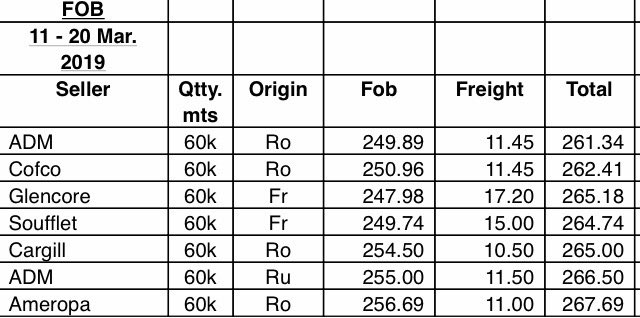
Ce qui a été proposé pour le GASC (Egypte) en blé;
2 roumains, puis 2 français puis 1 roumain puis 1 un seul russe, puis 1 roumain. Il y avait même du blé US moins cher que le Soufflet FOB, mais bien plus (trop) cher rendu. SRW Mississipi à 243.00 et HRW Texas à 249.00
3 « J'aime »
Du coup le wheat baisse…
1 « J'aime »
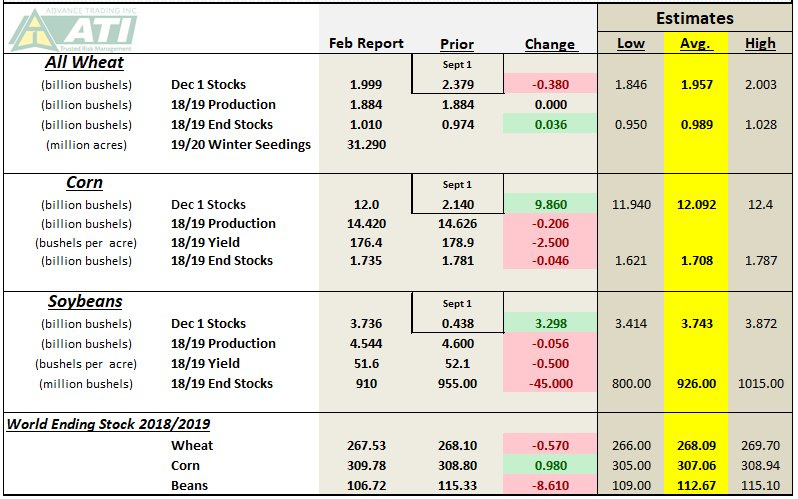
Au fait, vendredi 8 février, vont sortir (enfin) les nombreux chiffres et rapports de l’USDA!
On aura une avalanche de WASDE, de quayerly stocks, de productions 2018 et j’en passe.
Vendredi sera le jour le plus attendu depuis le shutdown.
Vendredi, tous les opérateurs humains et informatiques vont s’éclater et ça devrait swinguer. Attention les yeux ou plutôt les positions ouvertes.
3 « J'aime »
Effectivement, c’est ce que tout le monde attend. Quels sont vos prognostics ? Avec le USDA, on peut toujours craindre des stocks de derrière le fagot…
Les courtiers n’ont pas un discours vraiment pushing en physique en ce moment.
1 « J'aime »
Mes pronostics pour vendredi après chiffres et rapports sont développés ici : .
Voilà, je vous ai tout dit!
2 « J'aime »
Il est 0h15 ce 6 février. Si je ne me trompe, les marchés des grains vont swinguer dans un peu moins de 41h45mn maintenant avec les publications de l’USDA demain à 18 heures (heure française.)
2 « J'aime »
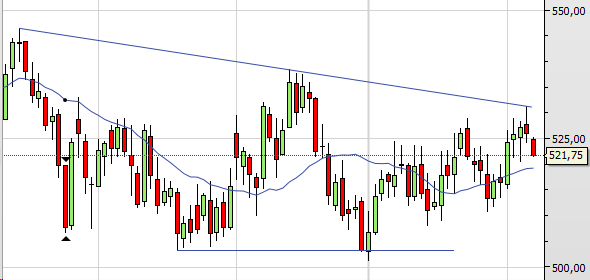
Toujours une grande précision technique en attendant
WHEAT JOUR
4 « J'aime »
Ce soir on aura une avalanche de données (par Ted Zeifried - Zaner) :
In January we missed a number of key USDA reports due to the government shutdown. The January WASDE, Quarterly Grain Stocks, Winter Wheat Seedings and the Crop Production and Annual Summary reports. This cluster of reports make the January release one of the most important of the year. Now we are set to get mostly caught up with the February release.
3 « J'aime »
Le dernier rapport USDA :
4 « J'aime »